beginquest.in

Uncategorized

Missed gst return filing deadline and common GST filing mistakes to avoid
Uncategorized

Missed a GST Return Filing Deadline? 7 Mistakes That Turn a ₹50 Late Fee Into a Notice

Missed a GST Return Filing Deadline? 7 Mistakes That Turn a ₹50 Late Fee Into a Notice It’s the 23rd of the month, and you’ve just remembered that the 20th has already passed. Your GSTR-3B is still unfiled. Most business owners react in one of two ways. Some panic and file in a rush. Others quietly hope nobody notices. Both reactions cause more damage than the delay itself. A missed GST return filing deadline is rarely the real problem. The mistakes people make in the days and weeks afterwards are. Here are the seven most common ones, and how to avoid each. What Happens If You Miss a GST Return Filing Deadline? A missed GST return deadline triggers an automatic late fee and interest on any unpaid tax. If the delay continues, it can also lead to blocked e-way bills, restricted input tax credit (ITC) and, eventually, cancellation of your GST registration. As per the rules in force, the late fee for GSTR-3B and GSTR-1 is ₹50 per day (₹25 CGST + ₹25 SGST), or ₹20 per day for nil returns. It is capped at a maximum amount per return. Interest at 18% per annum applies to the tax you paid late. Rules and caps get amended, so always confirm the current figures on the GST portal. A late GST return costs ₹50 a day. An ignored one can cost you your registration. What Does a Missed GST Return Filing Deadline Actually Cost? The late fee is the visible cost. The hidden costs are usually bigger: Late fee: accrues daily from the due date until the day you file. Interest: 18% per annum on the net tax paid in cash after the due date. Blocked e-way bills: you cannot generate e-way bills if returns are pending for a prolonged period. ITC trouble: your buyers may lose credit if your GSTR-1 is missing, which damages the relationship. Registration cancellation: the department can start cancellation if regular returns are not filed for six consecutive months. The 7 Most Common Mistakes After Missing a Deadline 1. Waiting “until the next month” to file Late fees run daily. Waiting a month to file two returns together means you pay two sets of penalties and interest. File the pending return first, then the current one. 2. Filing a nil return when you actually had sales Some owners file nil to “stop the late fee” and plan to fix it later. A nil return cannot be freely revised. Mismatches with GSTR-1 and e-invoice data trigger notices. Never file nil unless there were truly no outward supplies, no ITC and no tax payable. 3. Ignoring the GSTR-1 when you’ve filed GSTR-3B These two are linked. Filing 3B while GSTR-1 is pending leaves your customers without their ITC. Their accountants will start calling you, and not politely. 4. Paying interest and late fee from the wrong head The late fee and interest must be paid in cash, not from your ITC balance. Many people discover this only after the return is rejected or a demand appears. 5. Letting notices pile up unread A system-generated reminder (like GSTR-3A) is a warning, not a formality. Ignore it, and the next step can be an assessment order made on the department’s best judgement, often higher than your real liability. 6. Missing the ITC time limit ITC claims have a statutory time limit tied to the financial year-end or the annual return date. A long delay in online GST filing can make legitimate credit permanently unclaimable. 7. Doing everything in a panic, without reconciliation Rushed filing means mismatches between books, GSTR-2B and GSTR-1. This is how a ₹5,000 delay becomes a ₹50,000 notice. Reconcile first, then file. Real-World Example: How One Delay Snowballed (Composite example, details changed to protect client identity.) A Lucknow-based trading firm missed three monthly GSTR-3B returns because their part-time accountant left. They assumed they could “catch up at year-end.” By month four, e-way bills were getting blocked, and two large buyers withheld payments over missing ITC. Once the firm brought in professional GST filing services, the pending returns were reconciled and filed in a single week, in order, oldest first. They paid the late fees and interest, but registration stayed intact and buyers resumed payments. The delay cost a few thousand rupees. Ignoring it would have cost them the business relationships. Act Now vs. Wait: A Quick Comparison Factor File Within 1 Week Delay 3+ Months Ignore 6+ Months Late fee Minimal Substantial Likely at maximum cap Interest Small Growing at 18% Large E-way bill access Usually unaffected At risk Blocked Buyer ITC impact Negligible Disputes begin Lost clients Registration status Safe Warning notices Cancellation proceedings How to Fix Missed Returns: Step by Step Log in to the GST portal and check which returns are pending (GSTR-1, GSTR-3B, others). Download GSTR-2B and reconcile it with your purchase books. Calculate tax, interest and late fee for each pending period. File the oldest return first and move forward in order. Pay dues in cash through the correct challan heads. Respond to any notice within the deadline, with proper documents. Set calendar alerts for the 11th (GSTR-1) and the 20th (GSTR-3B) every month.   Should You Use GST Compliance Services or Do It Yourself? If you file one or two simple returns a month with clean data, self-filing can work. But GST compliance services become worthwhile when: You have multiple GSTINs or branches. Your sales or purchase volume is high. You’ve already missed more than one return. You’ve received a notice. Professional GST compliance services don’t just file. They reconcile, track due dates and catch errors before the department does. Why Work With a GST Consultant in Lucknow? A local GST consultant in Lucknow understands the state-level practicalities: Uttar Pradesh jurisdiction, local departmental processes and common industry patterns in the city’s trading and service sectors. You also get face-to-face access when a notice needs a quick, documented reply. The right consultant should give you a clear process, not just a
Company registration in India 2026 seven step process
Uncategorized

Company Registration in 2026: The 7-Step Process Everyone Skips (And Regrets)

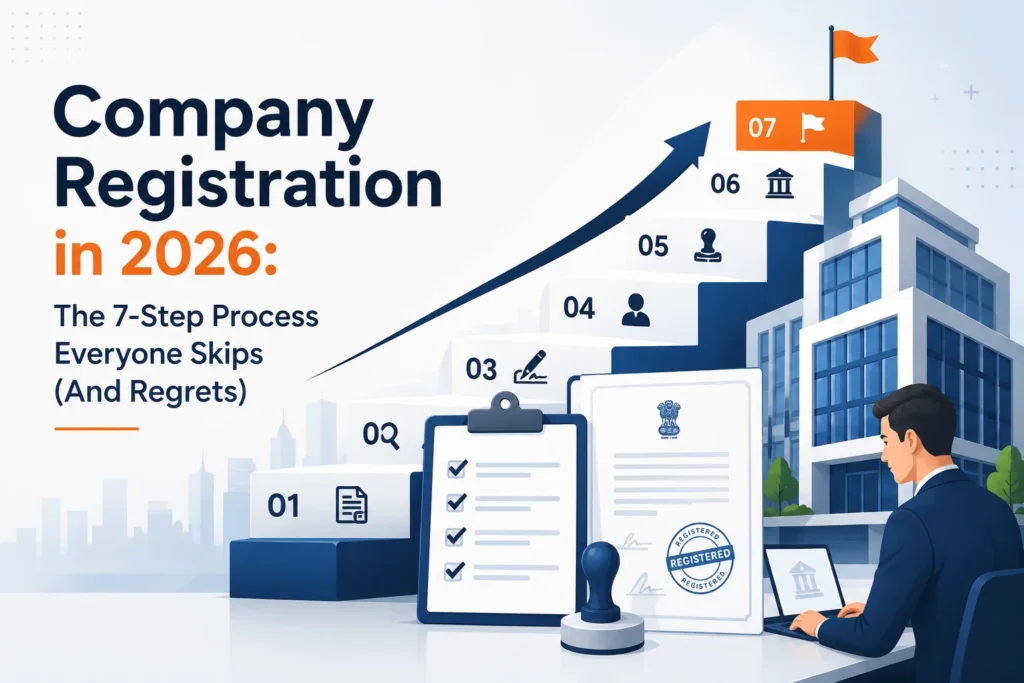
Company Registration in 2026: The 7-Step Process Everyone Skips (And Regrets) Most founders don’t fail at company registration because the process is hard. They fail because they trust a random YouTube video, skip a step, and end up with a company that’s technically registered but practically unusable — no bank account, no GST, no investor-ready paperwork. If you’re planning to register a business in 2026, here’s the uncomfortable truth: the MCA portal changed its interface again, DIN and DSC rules got stricter, and most “simple guide” blogs online are still describing a process from 2021. What Is Company Registration, Really? Company registration is the legal process of incorporating your business as a recognised entity — Private Limited, LLP, or OPC — with the Ministry of Corporate Affairs (MCA). Once registered, your company gets a Certificate of Incorporation, a PAN, a TAN, and a legal identity separate from you as an individual. This matters because an unregistered business can’t open a current account, can’t raise funding, and can’t legally issue invoices under a company name. The Real Company Registration Process in 2026 (Step-by-Step) Get a Digital Signature Certificate (DSC) for all proposed directors — mandatory for signing forms electronically. Apply for Director Identification Number (DIN) through the SPICe+ form itself; no separate DIN application needed anymore. Reserve your company name via the RUN or SPICe+ Part A service on the MCA portal — check availability first to avoid rejection. File SPICe+ Part B with MOA, AOA, registered office proof, and identity/address documents of directors. Complete PAN and TAN application — bundled automatically within the SPICe+ form since the last MCA update. Receive the Certificate of Incorporation (COI) — usually within 7-10 working days if documents are clean. Open a current bank account and apply for GST registration to actually start operating. Miss even one document mismatch in Step 4, and your entire filing gets sent back — resetting your timeline by two to three weeks. A Real (Anonymised) Example A Lucknow-based fintech founder came to us after his SPICe+ filing was rejected twice — once for a mismatched address proof, once for an incomplete MOA object clause. He’d spent nearly a month trying to self-file before switching to professional business registration services. The corrected filing was approved in nine days. This is the pattern we see repeatedly: it’s rarely the big steps that trip people up — it’s the small formatting and documentation details the MCA portal doesn’t clearly explain. Private Limited vs LLP vs Sole Proprietorship Feature Private Limited LLP Sole Proprietorship Legal identity Separate Separate Same as owner Liability Limited Limited Unlimited Funding-friendly Yes Limited No Compliance load High Medium Low Best for Startups, scaling businesses Professional services, small partnerships Solo, low-risk businesses Company Registration vs LLP Registration: Which One Fits You? If you’re planning to raise external funding or bring in investors, go with Private Limited company registration — it’s the only structure most investors will accept. If you’re a services business — consultants, agencies, small partnerships — LLP registration offers lower compliance with the same liability protection. There’s no universally “better” option here. The right call depends on whether you need outside capital in the next 2-3 years. Where Startup Registration Fits In Startup registration under the Startup India scheme (via the Startup India portal) is a separate, additional step — not a replacement for company registration. You still need to incorporate first (Private Limited or LLP), then apply for Startup India recognition to unlock tax exemptions and easier compliance for the first few years. Why Founders Increasingly Use Business Registration Services Doing it yourself is possible. But most delays we see come from three repeatable mistakes: incorrect object clause drafting, mismatched address proofs, and DSC-related technical rejections. Professional business registration services exist specifically to catch these before the MCA does — turning a potential 3-4 week delay into a 7-10 day approval. For founders based here, working with a company registration in Lucknow specialist also means someone who understands local municipal address-proof requirements and regional GST office timelines — details that generic national platforms often get wrong. You can read more on how we structure GST filings alongside incorporation in our GST registration guide, and if trademark protection is part of your 2026 plan, our trademark registration service walks through timing it correctly after incorporation. For the official process reference, the MCA’s SPICe+ guidelines remain the authoritative source — though, as this guide shows, reading them alone rarely prevents rejections. Frequently Asked Questions How long does company registration take in 2026? Typically 7-10 working days if all documents are accurate on the first submission. Filings with document mismatches can take 3-4 weeks due to resubmission cycles. Is LLP registration cheaper than Private Limited company registration? Yes, generally. LLP has lower government fees and simpler annual compliance, making it cheaper upfront and ongoing — but it limits your ability to raise equity funding later. Do I need startup registration separately after incorporating? Yes. Startup registration under Startup India is applied for after your company or LLP is incorporated — it’s a recognition status, not a replacement for incorporation. Can I complete company registration without professional help? Technically yes, through the MCA portal directly. Most self-filers face at least one rejection due to documentation errors, which is why many opt for business registration services instead. What documents are needed for company registration in Lucknow? PAN, Aadhaar, passport-size photos, and address proof of all directors, plus registered office proof (rent agreement/NOC + utility bill) specific to your Lucknow address. Is GST registration part of company registration? No, GST registration is separate and usually done immediately after receiving your Certificate of Incorporation, once you have your PAN and business bank account. Conclusion Company registration in 2026 isn’t harder than before — it’s just less forgiving of small mistakes. Get your documentation right the first time, choose the structure that matches your funding plans, and you’ll have a working, bank-ready company in under two weeks instead of two months.

Business registration services in India – what to register first before starting a business
Uncategorized

Business Registration Services in India: What to Register First (Before You Spend a Rupee)

Business Registration Services in India: What to Register First (Before You Spend a Rupee) Ravi had ₹40,000 sitting in a “business” savings account, a logo his cousin designed for free, and zero idea whether he needed a Private Limited company or just a GST number. He spent three weeks Googling before he registered anything — and then registered in the wrong order, which cost him a second round of paperwork. This happens more often than you’d think. Most founders don’t fail at registration because it’s hard. They fail because nobody tells them the sequence. What Does Business Registration Actually Mean? Business registration services cover the legal steps that turn an idea into a recognised entity — choosing a structure (proprietorship, partnership, LLP, or private limited), registering it with the right government body, and then layering on tax and scheme registrations like GST or MSME. Skip a step, or do them out of order, and you end up redoing paperwork you already paid for. The order matters more than the paperwork itself. Why the Sequence Trips People Up Here’s the trap: most first-time founders register for GST or MSME before they’ve even decided on a business structure. Then, when they later do proper company registration, the earlier registrations don’t map cleanly onto the new entity — new PAN, new GST number, new Udyam certificate, all over again. A cleaner approach, and one business registration services providers follow with every client, looks like this: Decide your structure — proprietorship, partnership, LLP, or Private Limited Company, based on liability and funding needs Register the entity — with the Ministry of Corporate Affairs for LLP/Pvt Ltd, or locally for proprietorship Apply for PAN and TAN in the entity’s name Complete MSME registration (Udyam) once the entity exists Register for GST if turnover crosses the threshold or you sell inter-state Open a current bank account using the certificates above Doing this out of order is the single biggest reason startup registration timelines stretch from 2 weeks to 2 months. Which Structure Should You Actually Pick? This is where most guides go vague. Here’s a direct comparison: Structure Best For Liability Compliance Load Typical Timeline Proprietorship Solo consultants, freelancers Unlimited (personal) Low 3-5 days Partnership Small family-run businesses Unlimited (shared) Low-Medium 5-7 days LLP Service businesses, agencies Limited Medium 10-15 days Private Limited Company Startups raising funds, scaling teams Limited Higher 10-20 days If you plan to raise investment, hire aggressively, or build something you’ll eventually sell, private limited company registration is almost always the right call — investors won’t fund a proprietorship. If you’re testing an idea solo with low risk, don’t over-engineer it; start simpler and convert later. A Real Pattern We See Often One Lucknow-based client — a small manufacturing setup — registered as a proprietorship, got a GST number, then six months later wanted to bring in a co-founder and apply for a business loan. Banks asked for a formal entity structure. He had to convert to a Private Limited Company, which meant a fresh company registration, fresh PAN, and re-doing his GST and MSME certificates under the new entity. Ten days of extra work that a 20-minute planning conversation would have avoided. If you already know you’ll need outside capital or partners within a year, register that way from day one. Do You Need MSME Registration Before Company Registration? No — and this is a common misconception. MSME registration (via the Udyam portal) should happen after your entity exists, because Udyam registration is tied to the PAN of the business, not an individual planning to start one. Registering MSME first, then forming a company later, means redoing the Udyam certificate under the new PAN. MSME status is still worth getting early once your entity is live — it unlocks collateral-free loans, delayed payment protection, and priority in government tenders, something we cover in more depth in our MSME registration guide. What About GST Registration Timing? GST registration is only mandatory once your turnover crosses ₹20 lakh (services) or ₹40 lakh (goods) in most states, or if you sell across state lines regardless of turnover. Registering for GST before you have real transaction volume just adds a monthly return filing burden with nothing to offset it. Wait until you’re close to the threshold, then register — our GST registration page walks through exact threshold rules by state. You can confirm current thresholds directly on the official GST portal (gst.gov.in). Documents You’ll Need, Broadly PAN and Aadhaar of all directors/partners Proof of registered office (rent agreement or ownership document) Digital Signature Certificate (DSC) for company/LLP filings — see our DSC guide Passport-size photographs and identity proof MOA and AOA drafts (for Private Limited Company) For Private Limited Company and LLP filings, everything routes through the Ministry of Corporate Affairs portal (mca.gov.in), so having your DSC ready before you start saves the most time. Frequently Asked Questions How long does private limited company registration take in India? Typically 10-20 working days, depending on name approval turnaround and document readiness. Delays usually come from incomplete address proof or DSC issues, not the process itself. Can I register a business without a physical office? Yes. A residential address with proper rent agreement or NOC works for registration purposes, especially for service-based businesses. Is MSME registration mandatory? No, it’s optional but highly recommended — it’s free, quick, and unlocks loan and tender benefits most small businesses eventually need. What’s the cheapest way to start a business in India? A proprietorship with GST registration (if applicable) is the lowest-cost route, but it offers no liability protection — weigh that trade-off against your risk exposure. Do I need a CA for company registration, or can I do it myself? Technically you can file it yourself through the MCA portal, but errors in MOA/AOA drafting or DSC setup are common and cause rejection delays — most founders find professional business registration services pay for themselves in saved time. What’s the difference between MSME and Udyam registration? They’re the same

Why Most Businesses Don't Fail From Bad Ideas — They Fail From No Strategy
Uncategorized

Why Most Businesses Don’t Fail From Bad Ideas — They Fail From No Strategy

Why Most Businesses Don’t Fail From Bad Ideas by Business Consulting — They Fail From No Strategy No — if anything, small and mid-sized businesses benefit more, since they usually don’t have an in-house strategy or finance team. A management consulting services engagement here isn’t about corporate-style overhauls; it’s about giving a lean team the structure a bigger company would already have. A business owner walked into our Gomti Nagar office last year with a simple complaint: “We’re busier than ever, but the numbers haven’t moved in eight months.” That’s not a rare story. It’s actually the most common reason businesses plateau — not a bad product, not a bad market, but the absence of a clear strategy behind all that effort. This is exactly the gap business consulting services are built to close. What Does a Business Consultant Actually Do? Strip away the jargon, and a business strategy consultant‘s job is simple: look at your business the way an outsider would, spot what’s actually holding growth back, and build a plan to fix it — then help you execute that plan instead of just handing you a PDF. “Most owners don’t need more ideas. They need someone to tell them which three things actually matter this quarter.” — a line we repeat to almost every new client. Why “Working Harder” Isn’t the Same as “Growing” Here’s the pattern we see again and again with SME owners: More hours, same output — the team is stretched thin doing tasks that don’t move revenue Reactive decisions — problems get fixed as they appear, with no forward plan Compliance handled last-minute — GST filings, MSME renewals, and licensing get treated as fire drills instead of routine No visibility into what’s actually working — no one’s tracking which service, product, or channel drives real profit A good business consulting firm doesn’t add more tasks to this list — it removes the noise and points the team at what actually matters. What Changes With Proper Consulting Without Consulting With Structured Consulting Reactive, day-to-day firefighting Quarterly roadmap with clear priorities Compliance handled last-minute GST and MSME filings on a fixed calendar Guesswork before funding applications Documentation ready before approaching lenders for a business loan No one owns the “big picture” A business development consultant tracking growth against a plan How the Process Actually Works Step 1 — Diagnosis. We study financials, operations, and market position — not a generic checklist, but specific to your business. Step 2 — Strategy design. A plan built around your real constraints: budget, team size, and timeline — not a copy-paste template. Step 3 — Implementation support. This is where most consulting stops short elsewhere. We stay involved while the plan is actually executed. Step 4 — Review and adjust. Markets shift. The plan gets revisited, not filed away. Mistakes We See Most Often Scaling up (hiring, inventory, new locations) before demand is actually validated Treating compliance like an afterthought — until RBI or MSME rule changes catch them off guard Applying for loans without financial documentation ready, leading to avoidable rejections Copying a competitor’s playbook without adapting it to their own numbers Every one of these is fixable before it becomes expensive — that’s the actual value of bringing in outside expertise early, not after a crisis. Is This Only for Large Businesses? No — if anything, small and mid-sized businesses benefit more, since they usually don’t have an in-house strategy or finance team. A management consulting services engagement here isn’t about corporate-style overhauls; it’s about giving a lean team the structure a bigger company would already have. Frequently Asked Questions What’s the real difference between “advice” and “consulting”? Advice is a suggestion. Consulting includes a plan, a timeline, and support through execution — not just a recommendation you’re left to figure out alone. How soon can I expect results? Compliance fixes can show results in weeks. Growth strategy typically plays out over one to two quarters as changes compound. Do I need to restructure my whole business to start? No. Most engagements start with one priority area — often compliance or cash flow — and expand from there. What makes a local firm like Beginquest different from a large national consultancy? On-ground understanding of the Lucknow market combined with the same compliance rigor as bigger firms, at a scale that fits SME budgets. Can consulting help before I even have a registered business? Yes — early-stage guidance on registration, structure, and compliance often prevents costly restructuring later. If your business feels busy but not growing, that’s rarely an effort problem — it’s a strategy problem. Business consulting services exist to turn scattered activity into a plan that actually compounds. Beginquest Services Pvt. Ltd., Gomti Nagar, Lucknow, works with businesses at exactly this stage — where the hustle is real, but the direction needs sharpening.

Uncategorized

Why Every Startup Needs a Business Consultant Before Launching

Why Every Business Needs a Startup Consultant Before Launching Launching a startup is exciting, but it also comes with uncertainty. From choosing the right business structure to understanding legal requirements and financial planning, many first-time founders make avoidable mistakes. Working with a startup consultant before launching helps reduce risks, improve decision-making, and create a stronger foundation for long-term growth. Whether you’re planning a technology startup, retail business, manufacturing unit, or service-based company, expert guidance can save both time and money while increasing your chances of success. Entrepreneurs can also explore various government support schemes through the Startup India initiative and the Ministry of MSME for startup recognition, funding opportunities, and MSME-related benefits. What Is a Startup Consultant? A startup consultant is a business professional who helps entrepreneurs transform an idea into a structured and legally compliant business. Instead of relying on trial and error, founders receive expert advice on planning, registrations, funding readiness, taxation, compliance, and growth strategy. Unlike general business advice available online, consultants provide personalized recommendations based on your business model, industry, location, and future goals. Many startups also work with a startup business consultant during their first year to build scalable processes and avoid common operational challenges. Why Do Startups Need Professional Guidance? Starting a business involves much more than registering a company. Founders often need to make important decisions such as: Choosing the right business entity Preparing a business roadmap Understanding tax obligations Managing registrations and compliance Creating realistic financial projections Identifying growth opportunities Without professional support, these decisions can lead to expensive corrections later. A qualified business setup consultant helps simplify these complex processes while allowing entrepreneurs to focus on developing their products and serving customers. Benefits of Hiring a Startup Consultant 1. Better Business Planning Every successful startup begins with a clear strategy. A consultant helps define: Business objectives Revenue model Target customers Competitive positioning Growth milestones This structured planning reduces uncertainty before launch. 2. Correct Business Registration Selecting the wrong legal structure may affect taxation, funding opportunities, and compliance. A business setup consultant helps determine whether your business should be registered as: Proprietorship Partnership LLP Private Limited Company One Person Company The right structure depends on your goals, investment, and expansion plans. 3. Financial Planning Cash flow problems are among the biggest reasons startups fail. Professional business advisory services help founders prepare: Startup budgets Cost estimates Pricing strategy Profit forecasts Break-even analysis These insights improve financial decision-making before launch. 4. Compliance Made Easy Many founders underestimate compliance requirements. Depending on your industry, you may require: GST Registration MSME Registration FSSAI License Shop & Establishment Registration Trademark Registration Professional Tax Import Export Code A startup consultant ensures that all required registrations are completed correctly and on time. 5. Reduced Business Risks Professional consultants identify potential issues before they become expensive problems. They help evaluate: Legal risks Financial risks Market competition Licensing requirements Operational bottlenecks Preventive planning often saves significantly more money than fixing mistakes later. How Does a Startup Consultant Work? Although every business is different, the consulting process usually follows these steps. Step 1: Understanding the Business Idea The consultant evaluates: Industry Products or services Business goals Budget Target customers Step 2: Market Assessment Research includes: Competitor analysis Customer demand Pricing trends Growth opportunities This helps validate whether the idea is commercially viable. Step 3: Business Structure Selection The consultant recommends the most suitable legal structure based on taxation, ownership, compliance, and future investment requirements. Step 4: Registrations & Documentation Necessary registrations are completed efficiently while ensuring documentation accuracy. Step 5: Launch Roadmap The startup receives guidance on: Business operations Marketing strategy Compliance calendar Financial management Scaling opportunities Key Business Advisory Services for Startups Professional consultants generally provide multiple services instead of only company registration. These include: Business Planning Creating structured launch plans and growth strategies. Company Registration Helping founders choose and register the appropriate business entity. GST Registration Ensuring tax compliance from the beginning. MSME Registration Helping eligible businesses access government schemes and benefits. Trademark Registration Protecting business identity and intellectual property. Compliance Management Monitoring statutory filings and regulatory requirements. Financial Advisory Supporting budgeting, taxation, and business planning. Many founders continue working with a small business consultant even after launch to improve operational efficiency and profitability. Common Mistakes Startups Make Without Professional Help Many businesses fail not because the idea is bad, but because execution lacks planning. Some common mistakes include: Choosing the wrong legal entity Ignoring compliance deadlines Mixing personal and business finances Poor budgeting Weak market research No customer validation Underestimating operational costs Delaying trademark registration Incorrect tax planning Working with a startup consultant significantly reduces these risks. Startup Consultant vs DIY Business Setup DIY Approach Professional Consultant Trial and error Structured planning Higher compliance risk Regulatory guidance Time-consuming Faster execution Limited expertise Industry knowledge Greater possibility of mistakes Reduced business risk Difficult documentation Professional documentation support Why Choose Professional Business Consulting? Professional consulting provides more than registrations. It offers strategic guidance throughout the business journey. An experienced startup business consultant understands: Industry regulations Market challenges Financial planning Business expansion Compliance management Instead of reacting to problems later, founders can prepare in advance. Businesses working with experienced consultants often launch with greater confidence because they understand both opportunities and responsibilities. Conclusion Launching a startup requires much more than enthusiasm and a good idea. Proper planning, legal compliance, financial management, and strategic execution all contribute to long-term success. Working with a startup consultant before launching gives entrepreneurs the confidence to make informed decisions, avoid common mistakes, and build a business on a strong foundation. Whether you need help with registrations, compliance, planning, or growth strategy, professional guidance can save valuable time and resources while increasing your chances of sustainable success. Frequently Asked Questions Is hiring a startup consultant worth it? Yes. A consultant helps avoid costly mistakes, simplifies legal compliance, improves planning, and provides structured guidance before launching the business. What does a startup consultant actually do? A startup consultant assists with business planning, registrations, compliance, financial strategy, documentation, and

How to Choose the Best Business Consultant in Lucknow (2026 Guide)
Uncategorized

How to Choose the Best Business Consultant in Lucknow (2026 Guide)

How to Choose the Best Business Consultant in Lucknow (2026 Guide) Finding the right business consultant in Lucknow can be confusing — every firm claims to be the best, but not every firm fits your specific business. The right consultant should understand your industry, your local market, and your growth stage before offering any advice. This guide breaks down exactly what to look for in 2026, so you can choose a business advisor in lucknow who actually delivers results instead of generic recommendations. What Is a Business Consultant? A business consultant in lucknow is a professional who studies your operations, finances, and market position to identify problems and design a practical growth strategy. Unlike generic online advice, a good consultant customizes their approach to your city’s specific business environment — local competition, customer behavior, and regulatory requirements. Some consultants specialize further: A corporate consultant typically works with larger, established companies on structure and scaling A startup consultant focuses on early-stage businesses — funding readiness, market entry, and lean operations Knowing which type you need is the first step to choosing correctly. Benefits of Hiring the Right Business Consultant in Lucknow Working with quality business consulting services in lucknow offers advantages that go beyond generic advice: Local market understanding — Lucknow’s business environment differs from metro cities; a local consultant knows the real dynamics Faster problem-solving — proven frameworks instead of trial and error Objective outside perspective — spotting blind spots internal teams miss Access to specialized expertise without a full-time hire Stronger, data-backed decision-making How Does the Selection Process Work? Choosing the right business consultant in Lucknow should follow a structured evaluation, not just a quick Google search. Step 1: Define Your Actual Problem Are you struggling with cash flow, marketing, compliance, or scaling? Different consultants specialize in different areas. Step 2: Check Industry-Specific Experience A corporate consultant experienced with manufacturing may not be the right fit for a D2C brand — match expertise to your industry. Step 3: Ask for Real Client Outcomes Request examples of businesses they’ve actually helped, not just a list of services offered. Step 4: Evaluate Communication and Process A good business advisor in lucknow will ask detailed questions about your business before proposing solutions — not the other way around. Step 5: Compare Pricing Models Some consultants charge hourly, others work on retainer or fixed-project pricing. Choose what matches your budget and engagement length. Important Features to Look For The best business consulting services in lucknow typically offer: Financial Planning & Analysis — budgeting, forecasting, loan readiness Marketing Strategy — local SEO, digital presence, brand positioning Operations Consulting — process efficiency and cost reduction Startup Advisory — ideal if you need a startup consultant for early-stage guidance Compliance Support — registrations, licensing, regulatory requirements specific to Uttar Pradesh Growth & Scaling Strategy — expansion planning for established businesses Common Mistakes When Choosing a Business Consultant Avoid these mistakes when evaluating a business consultant in lucknow: Choosing based on price alone, ignoring relevant experience Not verifying past client results before signing on Assuming one consultant fits every need — corporate vs. startup expertise differs significantly Skipping a discovery conversation before committing to a long engagement Ignoring local market knowledge in favor of generic, city-agnostic advice Why Choose Professional Help? Trying to solve complex business problems without expert guidance often costs more in the long run — through missed opportunities, poor financial decisions, or slow growth. A qualified business advisor in lucknow brings tested frameworks and local market insight that internal teams typically don’t have time to develop on their own. Whether you need a corporate consultant to restructure operations or a startup consultant to validate your early growth plan, professional guidance shortens the path between where your business is and where it needs to be. Frequently Asked Questions How do I find a reliable business consultant in Lucknow? Look for consultants with verifiable client outcomes, relevant industry experience, and a clear discovery process. Local reviews and referrals are also strong indicators of reliability. What’s the difference between a corporate consultant and a startup consultant? A corporate consultant typically works with established businesses on scaling and structure, while a startup consultant focuses on early-stage challenges like funding readiness and market entry. How much do business consulting services in Lucknow cost? Pricing varies by scope — hourly rates, fixed-project fees, or monthly retainers are all common. Request a custom quote based on your specific business needs. Do small businesses in Lucknow need a business consultant? Yes. Many small businesses benefit significantly, since a business advisor in lucknow helps avoid costly early mistakes without the cost of hiring full-time specialists. What questions should I ask before hiring a consultant? Ask about relevant industry experience, past client outcomes, their typical engagement process, and how they measure success. Can a business consultant help with funding or loans? Many consultants, especially those offering finance-focused business consulting services in lucknow, assist with loan documentation and improving loan eligibility. How long does a typical consulting engagement last? This depends on the scope — some projects are short and focused, while ongoing advisory relationships can last several months or longer. Conclusion Choosing the right business consultant in Lucknow comes down to matching expertise to your specific business stage — whether that’s a corporate consultant for scaling an established company or a startup consultant for early growth. Focus on real experience, proven outcomes, and local market understanding rather than the most polished pitch. The right partner won’t just give advice — they’ll help you execute a strategy built specifically for your business and your city.

What Is a Business Consultant? Roles, Benefits & Why Every Business Needs One
Uncategorized

What Is a Business Consultant? Roles, Benefits & Why Every Business Needs One

What Is a Business Consultant? Roles, Benefits & Why Every Business Needs One A business consultant is a trained professional who helps companies solve problems, improve performance, and plan for growth. In simple terms, a business consultant studies how your business operates, identifies gaps, and recommends practical solutions that save time, money, and effort. Whether you’re a startup founder trying to build a solid foundation or an established company looking to scale, working with a skilled business advisor can be the difference between guesswork and a clear, data-backed strategy. This article breaks down exactly what a business consultant does, why businesses hire them, and how to choose the right one. What Is a Business Consultant? A business consultant is an expert who provides professional advice to organizations to help them improve efficiency, profitability, and overall performance. They analyze existing business practices, identify weaknesses, and design strategies tailored to the company’s specific goals. Think of a business consultant as an outside expert with an inside understanding of your business. They bring: Industry experience across multiple sectors An objective, unbiased point of view Specialized knowledge in areas like finance, marketing, operations, or compliance Proven frameworks that have worked for other businesses facing similar challenges Unlike an employee, a consultant isn’t emotionally attached to existing processes — which is exactly why they can spot problems that internal teams often miss. Benefits of Hiring a Business Consultant Working with business consulting services offers advantages that go far beyond simple advice-giving. Here’s what businesses typically gain: 1. Fresh, Objective Perspective An outside expert sees your business without internal bias, making it easier to identify blind spots in strategy, operations, or team structure. 2. Faster Problem-Solving Instead of spending months trial-and-erroring a solution, a consultant applies proven methods that cut the learning curve significantly. 3. Cost Savings in the Long Run While hiring a consultant involves an upfront cost, the efficiency gains and mistake-avoidance usually save far more money than the fee itself. 4. Access to Specialized Expertise Most businesses can’t afford a full-time expert in every domain. A business growth consultant gives you that expertise on demand — without the cost of a permanent hire. 5. Better Decision-Making Consultants bring data, market research, and industry benchmarks that support smarter, faster decisions. 6. Scalable Growth Strategy A good consultant doesn’t just fix today’s problem — they help build systems and processes that support long-term, sustainable growth. How Does a Business Consultant Work? The process a business consultant follows is usually structured and goal-oriented. While every consultant has their own style, the general approach looks like this: Step 1: Business Assessment The consultant studies your current operations, financials, team structure, and market position to understand where things stand. Step 2: Problem Identification Based on the assessment, they pinpoint the specific issues holding the business back — whether that’s cash flow, marketing inefficiency, or operational bottlenecks. Step 3: Strategy Development A customized action plan is created, outlining clear steps, timelines, and measurable goals. Step 4: Implementation Support Many consultants don’t just hand over a report — they actively guide the execution, working alongside your team to put the plan into motion. Step 5: Monitoring and Adjustment Progress is tracked against goals, and strategies are refined as needed to keep the business on track. This is why businesses often see a business consultant as a long-term partner rather than a one-time service provider. Important Features or Services Offered A reliable business consulting firm typically offers a mix of the following services: Financial Consulting – budgeting, forecasting, and financial health checks Marketing Strategy – brand positioning, digital marketing, and customer acquisition planning Operations Consulting – process improvement and efficiency audits HR and Team Structuring – hiring strategy, org design, and performance systems Compliance and Regulatory Guidance – ensuring the business meets legal and industry requirements Business Growth Planning – expansion strategy, market entry, and scaling roadmaps Not every business needs every service — a good business advisor will recommend only what’s relevant to your specific stage and goals. Common Mistakes Businesses Make Without a Consultant Many businesses struggle simply because they try to handle everything internally, without outside expertise. Common mistakes include: Ignoring data-driven decisions and relying purely on instinct Scaling too fast without the operational systems to support growth Overlooking compliance requirements, leading to penalties later Inconsistent marketing efforts that fail to build a lasting brand presence Poor financial planning, resulting in cash flow issues during growth phases These mistakes are avoidable — and this is exactly where business consulting services add the most value, catching problems before they become expensive. Why Choose Professional Help? Some business owners hesitate to hire a business consultant, thinking they can figure things out on their own. But professional guidance offers something that self-learning often can’t: speed, accuracy, and accountability. A qualified business advisor has already seen the mistakes other businesses have made — and knows how to help you avoid them. Rather than learning through costly trial and error, you get a tested roadmap built specifically around your business’s needs. Choosing the right business consulting firm also means gaining a long-term partner who understands your industry, adapts to changing market conditions, and supports you through every growth stage — not just a one-time fix. Conclusion A business consultant brings the expertise, objectivity, and strategic thinking that many businesses need to move past growth plateaus and operational challenges. From financial planning to marketing strategy, the right business advisor doesn’t just solve today’s problems — they build the systems that support long-term success. If you’re serious about scaling efficiently and avoiding costly mistakes, partnering with an experienced business consulting firm is one of the smartest investments you can make for your business’s future.     Frequently Asked Questions What does a business consultant actually do? A business consultant analyzes your business operations, identifies inefficiencies, and provides strategic recommendations to improve performance, profitability, and growth. They may also help implement these strategies directly. How much does it cost to hire a business consultant? Costs vary

Business Loan Ke Liye Minimum CIBIL Score Kitna Hona Chahiye? Complete Guide 2026 by LS Tripathi, Financial Consultant at Beginquest Services Pvt. Ltd.
Uncategorized

Business Loan Ke Liye Minimum CIBIL Score Kitna Hona Chahiye? Complete Guide 2026

Business Loan Ke Liye Minimum CIBIL Score Kitna Hona Chahiye? Complete Guide 2026 Agar aap apne business ke liye loan lena chahte hain, toh sabse pehla sawaal yahi aata hai — CIBIL Score kitna hona chahiye? Short answer yeh hai: business loan ke liye generally 700 ya usse zyada CIBIL score ideal maana jaata hai. Lekin yeh ek simple number se zyada complicated topic hai. Agar aap Lucknow mein kisi trusted Financial Consultant in Lucknow se guidance lein, toh aap apne actual situation ke hisaab se sahi strategy bana sakte hain. Is article mein hum detail mein samjhenge ki alag-alag loan types ke liye CIBIL score ki requirements kya hain, low CIBIL score hone par kya options hain, aur score improve karne ke practical steps kya hain. CIBIL Score Kya Hota Hai Aur Yeh Kyun Important Hai? CIBIL Score ek 3-digit number hota hai jo 300 se 900 ke beech hota hai. Yeh aapki credit history, repayment behavior, aur financial discipline ko represent karta hai. Banks aur NBFCs is score ko dekh kar decide karte hain ki aapko loan dena chahiye ya nahi, aur agar dena hai toh kis interest rate par. CIBIL Score Range Loan Eligibility 750 – 900 Excellent – Best rates milti hain 700 – 749 Good – Approval chances high hain 650 – 699 Fair – Kuch lenders approve kar sakte hain 600 – 649 Poor – Collateral ya co-applicant needed 300 – 599 Very Poor – Loan milna mushkil Business Loan Ke Liye CIBIL Score Requirements — Bank vs NBFC vs MSME 1. Government Banks (SBI, PNB, BOB) Public sector banks generally 700+ CIBIL score maangti hain business loan ke liye. Inka process thorough hota hai aur documentation bhi zyada hoti hai. Interest rates kam hoti hain, lekin approval timeline 3–6 weeks tak ho sakta hai. 2. Private Banks (HDFC, ICICI, Axis) Private banks thoda flexible hain. 680–700 CIBIL score par bhi some products available hote hain, especially agar business ka turnover achha ho. Processing fast hoti hai — usually 7–10 business days mein decision aa jaata hai. 3. NBFCs (Bajaj Finserv, Lendingkart, FlexiLoans) NBFCs sabse zyada flexible hain aur 650 CIBIL score par bhi business loans offer karte hain. Unka focus sirf CIBIL par nahi, balki GST returns, bank statements, aur business vintage par bhi hota hai. Interest rates slightly higher hoti hain lekin approval quick hota hai. 4. MSME Loans (Government Schemes) Ek experienced MSME Loan Consultant in Lucknow yeh baat jaanta hai ki MUDRA Loan, CGTMSE, aur Standup India jaisi government schemes mein CIBIL requirement thodi relaxed hoti hai. Specially SC/ST aur women entrepreneurs ke liye 650 score par bhi loans available hain. Low CIBIL Score Hone Par Bhi Business Loan Ke Options Agar aapka score 650 se kam hai, toh ghabrane ki zaroorat nahi. Kuch practical options hain: Secured Business Loan: Property, FD, ya gold ke collateral par loan milna easy hota hai, chahe CIBIL score low ho. Lender ka risk kam hota hai isliye approval chances badhte hain. Co-Applicant ya Guarantor: Agar koi family member ya partner ka CIBIL score high hai, toh unhe co-applicant banana help kar sakta hai. NBFC ya Fintech Lenders: Ye lenders alternative data — jaise GST filing history, UPI transactions, aur business revenue — bhi consider karte hain. Microfinance Institutions: Small ticket loans ke liye MFIs ek achha option hain jo credit score par kam depend karte hain. Business Loan Consultant in Lucknow: Ek experienced Business Loan Consultant in Lucknow aapki profile ke mutabiq best lender match kar sakta hai, jo time aur rejection dono bachata hai. Business Loan Reject Kyun Hota Hai? Common Reasons CIBIL Score 700 se kam hona Past loan default ya late payments ka record Business vintage 2 saal se kam hona Insufficient turnover ya irregular bank transactions Multiple loan inquiries ek saath karna (hard inquiry se score girta hai) Incomplete ya incorrect documentation Inme se kaafi issues ko proactively address kiya ja sakta hai agar aap loan apply karne se pehle kisi MSME Loan Consultant in Lucknow se mil lein. Woh aapko bata sakte hain ki aapki application kaise strengthen karein. CIBIL Score Kaise Improve Karein? Practical Steps Step 1 — Credit Report Check Karein: CIBIL ki official website se apni free annual credit report download karein. Galat entries identify karein aur dispute raise karein. Step 2 — EMIs On Time Bharein: Payment history CIBIL score ka sabse bada factor hai (approximately 35%). Ek bhi missed payment score ko significantly impact karta hai. Step 3 — Credit Utilization Kam Rakhein: Apni credit card limit ka 30% se zyada use mat karein. High utilization negative signal deta hai. Step 4 — Unnecessary Loan Applications Band Karein: Har loan inquiry score thoda giraa deti hai. Apply karne se pehle eligibility check karein. Step 5 — Old Accounts Active Rakhein: Purani aur achhi standing wali credit accounts band mat karein — yeh credit history length maintain karta hai. Generally 6–12 mahine mein consistent positive behavior se CIBIL score 50–100 points tak improve ho sakta hai. Financial Consultant in Lucknow Se Business Loan Mein Kaise Help Milti Hai? Bahut saare business owners apna time aur reputation waste kar dete hain galat banks mein apply karke. Ek qualified Financial Consultant in Lucknow — jaise Beginquest Services Pvt. Ltd. ke experts — aapki complete financial profile analyze karte hain aur sirf unhi lenders ke paas approach karte hain jahan approval ki genuine chance ho. Beginquest Services, Gomti Nagar Lucknow mein based ek trusted financial consultancy firm hai jo businesses ko MSME registration, GST compliance, aur business loan facilitation mein help karti hai. Unki team har client ki unique situation ko samajh kar customized strategy banati hai. Ek achha Business Loan Consultant in Lucknow yeh karta hai: Aapki current CIBIL profile assess karta hai Loan ke liye sabse appropriate product aur lender suggest karta hai Documentation correctly prepare karne mein help karta hai Lender ke saath negotiation mein assist karta hai Rejection ka risk significantly kam karta hai FAQ Frequently Asked Questions Kya bina CIBIL score

Business Loan Kaise Prapt Kare Complete Guide 2026 featuring LS Tripathi, explaining business loan eligibility, required documents, application process, MSME loan options, and business finance solutions in India.
Uncategorized

Business Loan Kaise Prapt Kare? Complete Guide 2026

Business Loan Kaise Prapt Kare? Complete Guide 2026 Getting a business loan in India can feel overwhelming — especially when you don’t know where to start, which bank to approach, or what documents to prepare. Whether you’re starting a new venture or expanding an existing one, a Financial Consultant in Lucknow can be your biggest ally in navigating the loan process smoothly and successfully. This complete 2026 guide walks you through everything you need to know about business loans — step by step. What Is a Business Loan and Who Can Help You Get One? A business loan is a financial product offered by banks, NBFCs, and government schemes to fund business-related expenses — such as working capital, equipment purchase, office setup, or business expansion. However, applying for a loan without proper guidance often leads to rejection. That’s where a Business Loan Consultant in Lucknow plays a critical role. A professional consultant assesses your eligibility, prepares your documentation, and connects you with the right lender — significantly increasing your chances of approval. Types of Loans You Can Apply For One of the first things a qualified financial advisor will help you determine is which loan product suits your specific goal. Here’s a breakdown: Business Loan – For working capital, inventory, or operations Home Loan – For purchasing or constructing residential property Car Loan – For buying a new or used vehicle Project Loan – For large-scale industrial or infrastructure projects MSME Loan – For micro, small, and medium enterprises Personal Loan for Business – When collateral isn’t available Mudra Loan – Government-backed loan for small businesses under PM Mudra Yojana Each loan for business, car, home, or project has different interest rates, tenure periods, and eligibility criteria. A loan provider or financial consultant helps you match the right product to your needs. Benefits of Working With a Financial Consultant in Lucknow Many business owners try to handle loan applications on their own — and many face unnecessary delays or rejections. Here’s why working with the best Financial Consultant in Lucknow is a smarter move: 1. Expert Eligibility AssessmentBefore you even fill out a form, a consultant reviews your credit score, ITR, business vintage, and income proof — and tells you exactly which lenders you qualify with. 2. Documentation Made EasyMissing or incorrect documents are the #1 reason loan applications get rejected. A Business Loan Consultant in Lucknow ensures your file is complete and error-free before submission. 3. Access to Multiple LendersConsultants have tie-ups with multiple banks, NBFCs, and government schemes. This means you get the best interest rate, not just whatever a single bank offers. 4. Faster ProcessingBecause consultants know the internal processes of lenders, they can fast-track approvals — often getting disbursals in 3–7 working days. 5. End-to-End SupportFrom application to disbursal, a good financial advisor handles everything — so you can focus on running your business. How Does the Business Loan Process Work? Step-by-Step Here’s how the entire process works when you engage a professional loan service: Step 1 – Free ConsultationYou meet with the consultant, share your loan requirement and business details. Step 2 – Eligibility CheckThe consultant checks your CIBIL score, annual turnover, business age, and existing liabilities. Step 3 – Loan Product SelectionBased on your profile, the consultant recommends the best loan type and lender. Step 4 – Document CollectionYou provide KYC, business proof, ITR, bank statements, and any collateral documents if required. Step 5 – Application FilingThe consultant submits your application to the lender — correctly and completely. Step 6 – Follow-Up & VerificationThe consultant coordinates with the bank during their verification process. Step 7 – DisbursalOnce approved, the loan amount is disbursed directly to your bank account. Important Loan Services Offered by Financial Consultants reliable Financial Consultant in Lucknow typically offers the following loan services: Business Loan Assistance – Working capital, term loans, overdraft facilities Home Loan Guidance – Property valuation, lender comparison, subsidy claims under PMAY Car Loan Processing – New and used vehicle financing, lowest EMI calculation Project Loan for Industries – DPR preparation, lender tie-ups for large-scale projects Mudra & Government Scheme Loans – Shishu, Kishore, Tarun loan categories Balance Transfer – Moving your existing high-interest loan to a lower-rate lender Loan Against Property (LAP) – Unlocking the value of your property for business funds A full-service loan provider covers all these verticals under one roof — saving you time, money, and stress. Common Mistakes to Avoid When Applying for a Business Loan Even smart business owners make these costly mistakes. Knowing them in advance saves you from rejection: Applying without checking CIBIL score – A score below 650 will result in automatic rejection by most banks. Incomplete documentation – Missing ITR, bank statements, or GST returns delay or kill the application. Applying to multiple banks simultaneously – Multiple hard inquiries lower your credit score. Choosing the wrong loan product – A home loan cannot be used for business purposes and vice versa. Ignoring processing fees and hidden charges – Always ask for a full cost breakup before signing. Not comparing interest rates – A difference of even 1–2% on a ₹25 lakh loan can cost you lakhs over the loan tenure. This is exactly why consulting the best Financial Consultant in Lucknow before applying is a wise first step — not an afterthought. Why Choose Professional Help? The Role of a Financial Advisor When it comes to finances, DIY often costs more than professional help. Here’s what sets a trained financial advisor apart: A professional consultant doesn’t just fill forms — they analyze your complete financial health and create a strategy. They know which lenders are currently offering the best rates, which government schemes you qualify for, and how to present your application in the strongest possible light. Moreover, a Business Loan Consultant in Lucknow who operates locally understands the local market — the industries that are booming in UP, the lenders active in Lucknow, and the documentation norms specific to Uttar Pradesh-based businesses. Whether you need a

Partnership Registration in Lucknow – Expert Services by Beginquest
Uncategorized

Partnership Registration in Lucknow: Complete 2026 Guide for Startups & Businesses

Partnership Registration in Lucknow: Complete 2026 Guide for Startups & Businesses Looking to start a business with partners in Lucknow? Partnership Registration in Lucknow is one of the easiest and most cost-effective ways to legally start a startup, agency, trading business, consultancy, or small company in 2026. A registered partnership firm offers legal recognition, shared ownership, simple compliance, and better business credibility. From Partnership Deed drafting to firm registration, PAN, GST, and bank account setup, this complete guide covers everything you need to know about Partnership Firm Registration in Lucknow for startups and growing businesses. Starting a Business in Lucknow? Here’s What You Need to Know First Partnership registration in Lucknow is one of the most straightforward and affordable ways to legally establish your business. Whether you’re two friends starting a local venture or a group of professionals building a consultancy, a registered partnership firm gives your business a solid legal foundation. Lucknow, the capital of Uttar Pradesh, is one of the fastest-growing business cities in North India. With a booming startup ecosystem, a thriving MSME sector, and increasing government support for small businesses, this is the perfect time to register your partnership firm and get things moving. In this guide, we’ll walk you through everything — from what a partnership firm is, to how to get partnership deed registered, required documents, fees, timelines, and how Beginquest Services Pvt Ltd can make the entire process seamless for you.a What Is a Partnership Firm? A partnership firm is a business structure where two or more individuals (called partners) come together to carry on a business with a shared profit and loss arrangement. It is governed by the Indian Partnership Act, 1932. There are two types of partnership firms in India: Registered Partnership Firm – Formally registered with the Registrar of Firms Unregistered Partnership Firm – Operating without formal registration (has legal limitations) While an unregistered firm can legally exist, a registered partnership firm has significant advantages in terms of legal protection, banking, contracts, and disputes. Why Register a Partnership Firm in Lucknow? Many entrepreneurs wonder whether registration is truly necessary. Here’s why it matters — especially in a competitive city like Lucknow: Legal Recognition – Your firm gets official status under the Indian Partnership Act Better Access to Bank Loans – Banks in Lucknow prefer lending to registered firms Right to Sue – A registered firm can file legal suits against third parties or defaulting partners Government Tenders – Many government contracts in UP require a registered entity GST & Tax Compliance – Easier to open GST accounts and file returns Credibility with Clients – Registered firms build instant trust with vendors and customers Partnership registration in Uttar Pradesh is especially important if you plan to apply for state government schemes, MSME benefits, or expansion loans. Partnership Registration in Lucknow – Step-by-Step Process Here is a clear, step-by-step breakdown of how to get a partnership deed registered in Lucknow: Draft a Partnership Deed     The partnership deed is the core document. It must include the firm’s name, partners’ details, capital contribution, profit-sharing ratio, roles, and terms of exit or dissolution. A lawyer or registered agent (like Beginquest) can help draft this correctly. Get the Deed Notarized     The deed must be printed on stamp paper of appropriate value and signed by all partners in the presence of a notary or lawyer. File Application with the Registrar of Firms (RoF)     Submit Form 1 (Application for Registration) along with the signed partnership deed to the partnership firm registration office in Lucknow (under the UP Registrar of Firms). Pay the Registration Fees     Pay the required government fees for partnership registration in UP. Fees vary by state and type of partnership deed. Receive the Certificate of Registration     Once verified, the Registrar issues a Certificate of Registration. Your firm is now officially registered under partnership registration in Uttar Pradesh.   Tip: Beginquest Services handles all of this for you — from drafting the deed to filing and follow-up. Documents Required for Partnership Registration Here’s a complete checklist of documents you’ll need: Partnership Deed (on stamp paper) – signed by all partners PAN Card copies of all partners Aadhaar Card or Voter ID of all partners Passport-size photographs of all partners Proof of business address (electricity bill / rent agreement / NOC from owner) Form 1 – Application for Registration of Firm Affidavit (if required by the Registrar’s office) Make sure all documents are self-attested and properly signed before submission. Partnership Registration Fee in Uttar Pradesh – 2026 Update Understanding the cost is important before you proceed. Below is a general fee structure for partnership registration in UP: Fee Component Estimated Amount Stamp Duty on Partnership Deed Rs. 500 – Rs. 2,000 (varies) Government Registration Fee Rs. 100 – Rs. 500 (approx.) Notary & Drafting Charges Rs. 500 – Rs. 1,000 (approx.) Professional Service Fee (Beginquest) Affordable – Contact us for quote Note: Stamp duty rates in UP may vary based on the value of capital and type of deed. Contact Beginquest for an exact quote: 9616125261. Partnership Firm Registration Office in Lucknow The official authority for partnership firm registration in Lucknow is the Registrar of Firms, Societies and Chits, Uttar Pradesh. The office operates under the UP government and is responsible for maintaining the register of all partnership firms in the state. For online applications and government portal access, you can visit the UP government’s official portal or submit via the firm registration section. You can also refer to the Ministry of Corporate Affairs website at mca.gov.in for broader business registration queries. If you find the process confusing or time-consuming, Beginquest Services Pvt Ltd handles all interactions with the registration office on your behalf — saving you hours of paperwork and follow-up. Online Partnership Registration in Lucknow – Is It Possible? Yes! Online partnership registration in Lucknow is now possible through the UP government’s official business registration portal. This allows partners to: Upload scanned documents digitally Pay fees online via net banking or UPI Track application status

Scroll to Top