
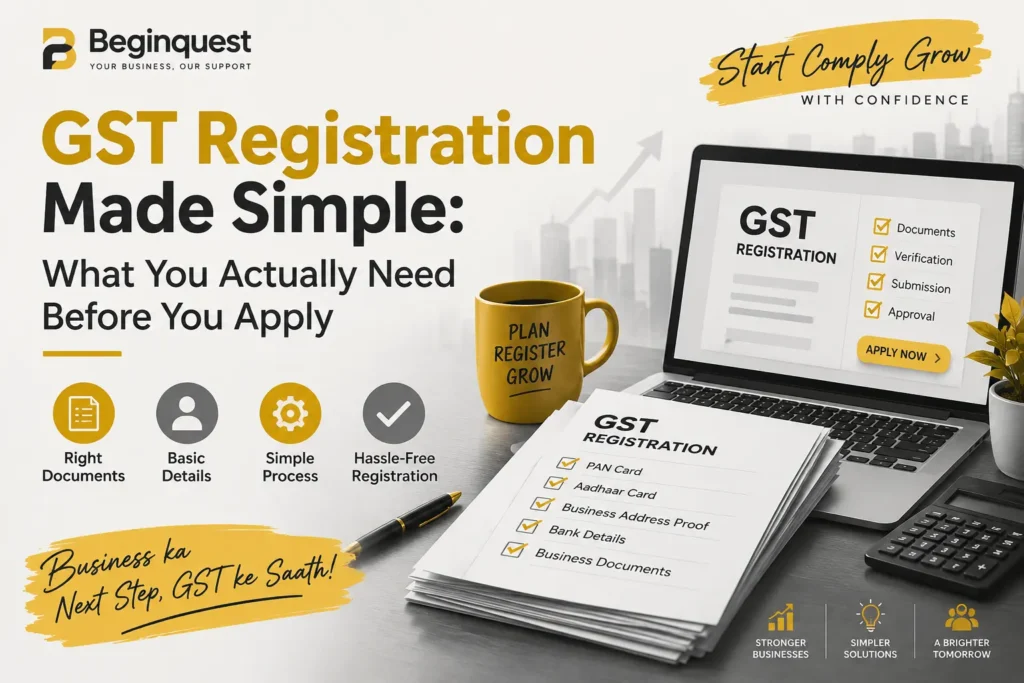
GST Registration Made Simple: What You Actually Need Before You Apply
GST Registration Made Simple: What You Actually Need Before You Apply Ever filled out the GST portal form, hit submit, and then got an “ARN generated” message followed by… silence? Or worse — a rejection notice three days later because one document didn’t match another? That’s not bad luck. That’s what happens when gst registration is treated as a form-filling exercise instead of a document-matching exercise. The application itself takes 20 minutes. Getting it approved on the first try is where most businesses stumble. This guide skips the fluff and tells you exactly what you need lined up before you touch the GST portal — so your application doesn’t bounce back. What Is GST Registration? GST registration is the process of enrolling your business on the government’s GST portal to get a unique 15-digit GSTIN (GST Identification Number). Once registered, you’re legally allowed to collect GST from customers, claim input tax credit, and issue GST-compliant invoices. Without it, you simply cannot operate as a recognized taxpayer under India’s indirect tax system. Who Actually Needs to Register? Businesses with annual turnover above ₹40 lakh (goods) or ₹20 lakh (services) — ₹10 lakh in special category states Anyone doing inter-state supply of goods, regardless of turnover E-commerce sellers, casual taxable persons, and non-resident taxable persons Businesses under the reverse charge mechanism If you fall into any of these buckets, registration isn’t optional — it’s a legal requirement, and delaying it just adds penalty exposure later. The Documents That Actually Matter Most rejections don’t happen because of missing documents. They happen because of mismatched documents — an address on the electricity bill that doesn’t match the rent agreement, or a PAN name that doesn’t exactly match the Aadhaar name. Document Type What’s Needed Common Mismatch Issue Identity Proof PAN card of proprietor/partners/directors Name spelling differs from Aadhaar Business Address Proof Rent agreement + latest electricity/water bill Bill address doesn’t match agreement Business Constitution Partnership deed / Incorporation certificate / MSME certificate Missing for new entities Bank Details Cancelled cheque or bank statement Account not yet in business name Photograph Passport-size photo of applicant Wrong file size/format on portal Digital Signature DSC (mandatory for companies/LLPs) Not procured before applying Get these seven aligned before you start the application, and you eliminate 90% of the reasons applications get sent back for clarification. “Businesses don’t lose time on GST registration itself — they lose time re-answering government queries because one document didn’t match another.” How to Apply for GST Registration Online — Step by Step Visit the GST portal and go to Services > Registration > New Registration Fill Part A with PAN, mobile number, and email — you’ll get an OTP-verified TRN (Temporary Reference Number) Fill Part B using the TRN — business details, promoter/partner details, principal place of business, and goods/services (HSN/SAC codes) Upload documents exactly as per the table above, in the specified file size and format Verify via DSC, e-Sign, or EVC depending on your business type Track your ARN (Application Reference Number) for status updates Respond promptly if the officer raises a clarification — delays here are the #1 cause of extended timelines Done correctly, gst registration online typically takes 3-7 working days. Done with mismatched paperwork, it can stretch to 3-4 weeks of back-and-forth. A Real Scenario We See Often A small trading firm in Lucknow applied for GST registration on their own using a rent agreement in the owner’s personal name, while the electricity bill was still in the previous tenant’s name. The application got flagged for clarification twice, costing them nearly three weeks — weeks during which they couldn’t legally invoice a client who required a valid GSTIN. Once the address proofs were corrected and resubmitted together, approval came through in four days. The lesson isn’t “GST registration is hard.” It’s that document consistency, not paperwork volume, is what determines your timeline. Should You Do It Yourself or Hire a GST Consultant? Self-filing works fine if your business structure is simple — single proprietorship, one place of business, no HSN complications. But the moment you have multiple partners, an LLP structure, inter-state operations, or a history of PAN/Aadhaar mismatches, a GST registration consultant becomes worth the fee just to avoid rework cycles. At Beginquest Services Pvt. Ltd., based in Gomti Nagar, Lucknow, we see the same pattern repeatedly: businesses that try DIY registration with even one document inconsistency end up spending more time (and sometimes more money in lost invoicing days) than they would have spent on professional help upfront. Our take: if your structure is simple and your documents are clean, file it yourself. If either isn’t true, don’t gamble three weeks on it. DIY vs Hiring a GST Consultant Factor DIY Filing Hiring a GST Consultant Cost ₹0 (government fee is nil) Consultant fee applies Time (if error-free) 3-7 days 3-7 days Time (if documents mismatch) 2-4 weeks Rarely happens — pre-checked Error Handling You respond to notices yourself Consultant drafts responses Best For Simple proprietorships Partnerships, LLPs, multi-state, complex structures GST Number Registration: What Happens After Approval Once your GST number registration is approved, you’ll receive your GSTIN and registration certificate (Form GST REG-06). From here, you’re required to: Display your GSTIN at your place of business Issue GST-compliant invoices from day one File returns as per your applicable scheme (regular or composition) Update the portal if your address, bank details, or business structure changes Missing these post-registration steps is a separate compliance risk many businesses overlook — registration is the start, not the finish line. For a deeper look at what comes next, our guide on GST return filing for small businesses walks through the monthly and quarterly cycle. If you’re still deciding on business structure before registering, our proprietorship vs LLP comparison is worth reading first. You can also verify current turnover thresholds directly on the official GST portal or check the latest notifications from the Central Board of Indirect Taxes and Customs. If your documentation feels uncertain, working with a