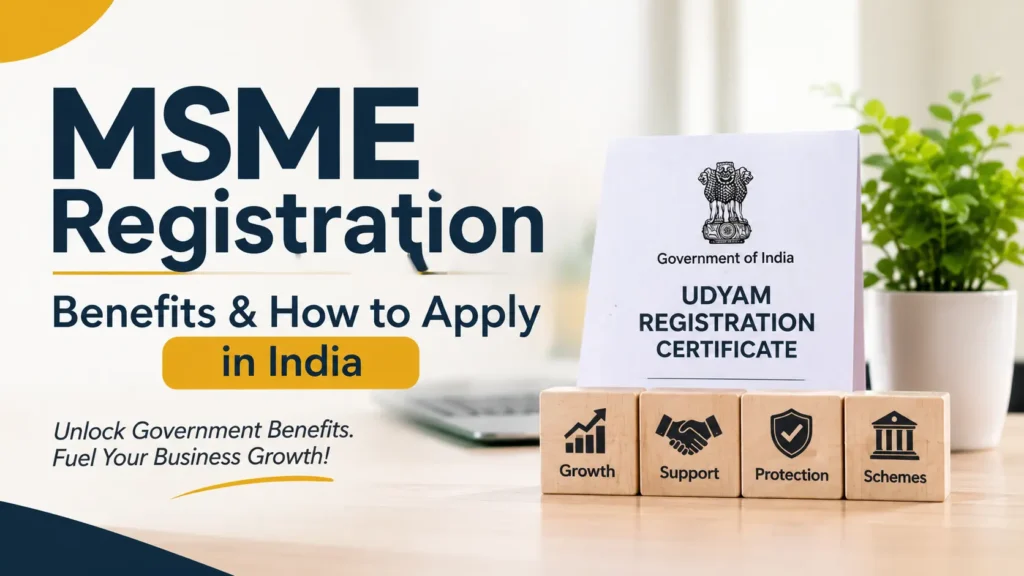
MSME Registration – Benefits and How to Apply in India
Imagine running a small manufacturing unit, consultancy, retail shop or service business. You have customers, regular expenses and plans to expand. But when you approach a bank, explore a government tender or look for business support schemes, you discover that your business could benefit from formal MSME recognition.
This is where MSME registration becomes important.
Many entrepreneurs believe that MSME registration is only useful for manufacturing companies. That is not correct. Eligible service businesses and other enterprises can also obtain Udyam registration under the applicable government classification.
In India, Udyam registration gives an eligible enterprise official recognition as a Micro, Small or Medium Enterprise. It can help businesses access applicable government schemes, institutional credit opportunities and certain protections available under MSME laws.
The bigger question is not simply whether you should register. It is whether your business is eligible and how you can use that recognition strategically.
Let’s understand the process, benefits and important considerations.
What Is MSME Registration?
MSME registration is the government registration process through which an eligible enterprise receives recognition as a Micro, Small or Medium Enterprise under the Ministry of Micro, Small and Medium Enterprises.
The registration is completed through the official Udyam Registration Portal. After successful registration, the enterprise receives a permanent Udyam Registration Number and an electronic certificate.
Udyam registration is:
Completely online.
Paperless and based on self-declaration.
Free on the official government portal.
Linked with applicable PAN and GST information.
Available to eligible manufacturing and service enterprises.
An important distinction: Udyam registration is not the same as incorporating a company. It does not create a new legal entity or replace GST registration, company incorporation or other mandatory licences.
Who Is Eligible for MSME Registration in India?
Businesses are classified as Micro, Small or Medium Enterprises based on investment in plant and machinery or equipment and annual turnover.
The revised classification became effective on 1 April 2025.
Latest MSME Classification Limits
| Enterprise category | Investment limit | Annual turnover limit |
|---|---|---|
| Micro | Up to ₹2.5 crore | Up to ₹10 crore |
| Small | Up to ₹25 crore | Up to ₹100 crore |
| Medium | Up to ₹125 crore | Up to ₹500 crore |
These are the prescribed ceiling limits. Both investment and turnover criteria are considered for classification.
The revised limits are particularly relevant for growing businesses that previously crossed the older MSME thresholds.
Which Businesses Can Apply?
Eligible enterprises may include:
Sole proprietorship businesses.
Partnership firms.
Limited Liability Partnerships (LLPs).
Private Limited Companies.
One Person Companies (OPCs).
Manufacturing units.
Consultancy and professional service businesses.
Eligible trading enterprises.
Retail and wholesale traders can also register on the Udyam portal, but their MSME benefits are limited, particularly regarding priority sector lending. Do not assume that every benefit available to manufacturing or service enterprises automatically applies to traders.
Why Should Your Small Business Get MSME Registered?
MSME registration is more than a certificate. It can provide access to opportunities that may otherwise be difficult for a small business to explore.
Here are seven important reasons to consider it.
1. Better Access to Business Finance
Banks and financial institutions have lending facilities and products for eligible MSMEs.
Udyam recognition can help establish your enterprise’s MSME classification when approaching lenders. Depending on the scheme, bank policy and eligibility, businesses may explore working capital, machinery finance and other business credit facilities.
However, registration alone does not guarantee loan approval. Banks still evaluate financial records, repayment capacity, credit history and business viability.
2. Eligibility for Applicable Government Schemes
The Ministry of MSME and other government departments operate schemes to support eligible enterprises.
Depending on the nature of your business, you may explore:
Credit-linked assistance programmes.
Technology and quality improvement initiatives.
Entrepreneurship development programmes.
Skill development opportunities.
Market access and export-related support.
Applicable subsidy or reimbursement schemes.
Each scheme has separate eligibility requirements. A Udyam certificate does not automatically qualify every business for every subsidy.
3. Support Against Delayed Payments
Delayed customer payments can create serious cash-flow problems for small businesses.
Under the MSMED Act, qualifying Micro and Small Enterprises have statutory protections concerning delayed payments from buyers.
The law generally provides that an agreed payment period cannot exceed 45 days from acceptance or deemed acceptance of goods or services.
Eligible enterprises with valid Udyam registration can use the MSME Samadhaan mechanism to submit delayed-payment applications for consideration by the appropriate Micro and Small Enterprise Facilitation Council.
This is an important reason for eligible businesses to understand their MSME status.
4. Opportunities in Government Procurement
Government departments and public sector organisations have procurement policies that support eligible Micro and Small Enterprises.
Depending on the applicable tender and procurement conditions, registered businesses may benefit from certain procurement preferences, exemptions or participation opportunities.
For businesses planning to supply products or services to government departments, MSME recognition can be a useful part of their registration and documentation strategy.
Remember that tender-specific conditions still apply.
5. Improved Business Recognition
A Udyam certificate provides a recognised government registration reference for your enterprise.
It can be useful when dealing with banks, financial institutions, procurement authorities and other organisations that request MSME details.
It also helps maintain a more organised business documentation profile.
6. Support for Business Expansion
As a business grows, it may need new machinery, additional employees, better technology or larger working capital facilities.
MSME recognition can help eligible enterprises explore government support programmes and institutional facilities designed for business development.
It is particularly useful for businesses that want to move from informal operations towards a more organised business structure.
7. A Better Foundation for Startup and Business Growth
New entrepreneurs often focus on finding customers and generating revenue. However, business documentation is equally important.
Along with suitable entity formation, tax registration and industry-specific licences, Udyam recognition can strengthen a business’s formal registration profile.
For eligible enterprises, it can become one part of a long-term growth strategy.
A business registration certificate does not grow your business by itself. But the right registrations can open doors to opportunities that help your business grow.
Udyam Registration vs Other Business Registrations: What's the Difference?
Entrepreneurs frequently confuse MSME registration with company incorporation and GST registration.
These registrations serve different purposes.
| Registration | Main purpose | Is it the same as Udyam? |
|---|---|---|
| Udyam registration | MSME recognition | Yes, this is the MSME registration system |
| GST registration | GST tax compliance | No |
| Private Limited registration | Creates a company as a legal entity | No |
| LLP registration | Creates a limited liability partnership | No |
| Startup India recognition | Recognition under the DPIIT Startup framework | No |
For example, a newly incorporated Private Limited Company may also qualify for Udyam registration if it meets the MSME classification requirements.
Similarly, a proprietorship does not need to become a Private Limited Company simply to apply for Udyam registration.
The correct structure depends on the business’s ownership, liability, taxation and growth requirements.
How to Apply for Udyam Registration Online: Step-by-Step Process
with the authorised signatory’s Aadhaar information.
Step 4: Enter Business Information
Provide the required information, including:
Business or enterprise name.
Organisation type.
Business address.
Bank account details.
Commencement date.
Business activities.
Applicable NIC code.
Employee information.
Check that the information matches your actual business records.
Step 5: Submit the Application
Review the information carefully and complete the required declarations.
Submit the application through the portal.
Step 6: Receive Your Udyam Certificate
After successful completion and verification of the registration process, the portal generates the Udyam Registration Number and electronic certificate.
Keep your certificate safely for future reference.
What Documents Are Required for MSME Registration?
One major advantage of Udyam registration is that it does not require applicants to upload a collection of supporting documents during the normal registration process.
However, you should keep the relevant information ready:
Aadhaar number of the proprietor or authorised person.
Applicable PAN details.
GSTIN, wherever applicable.
Business address.
Bank account details.
Business activity information.
Investment and turnover information, where required.
The portal obtains applicable investment and turnover information through linked government databases.
Make sure that the information submitted is accurate and consistent with official records.
Should You Apply Yourself or Hire an MSME Registration Consultant?
The official registration process is free, so entrepreneurs can complete it themselves.
However, some businesses prefer professional guidance, especially when they are unfamiliar with entity details, NIC codes, business activities or linked tax information.
A suitable MSME registration consultant can help with:
Understanding eligibility.
Selecting the correct organisation type.
Checking business information.
Identifying suitable business activity codes.
Reviewing application details.
Providing assistance with corrections and subsequent updates.
Professional assistance is particularly useful when MSME registration is being handled alongside other business registration services.
For example, a startup may need guidance on company incorporation, GST registration, Udyam registration and other applicable licences.
At Beginquest Services Pvt. Ltd., Gomti Nagar, Lucknow, entrepreneurs can explore business registration and compliance assistance under one roof.
You can also explore our business consulting services, GST registration assistance and GST return filing services.
Important: Private consultants may provide advisory and application assistance, but the government registration itself is completed through the authorised government portal. The government does not charge a Udyam filing fee. Always ask for transparent professional service charges and access to your certificate.
Common Mistakes to Avoid During MSME Registration
Before applying, watch out for these mistakes:
Using unofficial websites: Always use the official Udyam portal for government registration.
Incorrect Aadhaar details: Ensure the Aadhaar holder is appropriate for the business structure.
Wrong organisation type: Select the actual legal structure of the enterprise.
Incorrect business activities: Choose relevant activities and NIC codes.
Ignoring PAN and GST details: Ensure applicable information is accurate.
Assuming automatic benefits: Check individual scheme conditions before applying.
Creating duplicate registrations: An enterprise should not obtain multiple Udyam registrations for the same enterprise.
Conclusion: Is MSME Registration Worth It for Your Small Business?
For an eligible small business, MSME registration can be a valuable step towards formal recognition and organised growth.
It can help enterprises explore applicable government schemes, institutional finance, procurement opportunities and delayed-payment protections.
The best time to understand your MSME eligibility is before you need a business loan, government tender or expansion support.
If you are starting a new business or already operating a small enterprise, review your business structure and classification requirements carefully.
Beginquest Services Pvt. Ltd., based in Gomti Nagar, Lucknow, provides guidance and assistance for Udyam registration, startup registration and other business compliance requirements.
Make informed registration decisions today and build a stronger foundation for tomorrow.
Frequently Asked Questions
Yes. Udyam registration is completely free when completed through the official Government of India portal. There is no government filing fee. If you hire a private consultant, professional assistance charges may apply separately. Always distinguish between government fees and optional consultancy charges.
Yes. Eligible service enterprises can obtain Udyam registration. The scheme is not restricted to manufacturing units. Consultants, IT service providers, professional firms and other eligible service businesses can apply according to the applicable classification requirements.
GSTIN is required where applicable under GST law and the Udyam registration requirements. Businesses that are not required to obtain GST registration under the applicable rules should not assume that GST registration must be obtained solely for Udyam registration.
Yes. A proprietorship can apply for Udyam registration using the proprietor’s Aadhaar and applicable PAN and business details. It is not necessary to convert a proprietorship into a Private Limited Company merely to obtain MSME recognition.
No. Udyam registration does not guarantee loan approval. It helps establish MSME classification for applicable lending facilities, but banks and financial institutions assess repayment capacity, credit history, financial records, business viability and their lending policies before approving finance.
Yes. A person intending to establish an eligible micro, small or medium enterprise can file Udyam registration. New entrepreneurs should provide accurate information about their business activities, structure and applicable details.
MSME registration provides recognition under the Ministry of MSME based on investment and turnover criteria. Startup India recognition is a separate DPIIT recognition framework with its own eligibility conditions. A business may qualify for both, provided it meets the respective requirements.