
Income Tax Return Filing for Salaried Employees: 8 Mistakes Your Form 16 Won't Warn You About
You have a steady salary, a Form 16 from your employer and a pre-filled return waiting on the portal. What could go wrong?
Quite a lot, as it turns out. Most salaried taxpayers believe income tax return filing is the easy kind, because the employer has already “done the tax”. But Form 16 shows only what your employer knows. The Income Tax Department knows much more.
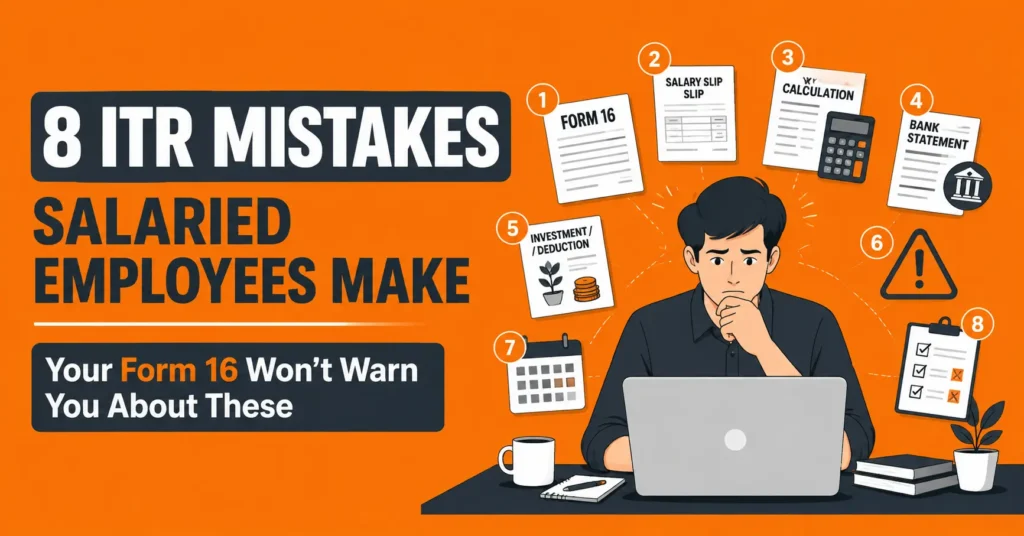
Here are the eight mistakes we see most often, and how to avoid each one.
What Is Income Tax Return Filing for Salaried Employees?
Income tax return filing for salaried employees is the yearly declaration of your salary, other income, deductions and taxes paid, submitted to the Income Tax Department through the e-filing portal.
Your employer deducts TDS during the year. Your return is where you confirm that the figure is correct, add income your employer doesn’t know about and claim a refund if you overpaid.
Form 16 tells you what your employer reported. Your AIS tells you what the department knows. File for the second one.
The 8 Mistakes Salaried Employees Make
1. Treating Form 16 as the Full Picture
Form 16 covers only salary and TDS from that employer. It doesn’t show your bank interest, dividends, mutual fund sales or freelance credits.
Before you start, download your Annual Information Statement (AIS) and Form 26AS from the Income Tax e-filing portal and compare all three.
2. Forgetting Interest and Other Income
Savings account interest, fixed deposit interest and dividends are taxable. Banks often deduct TDS on them, which means the department already has the data.
If your return misses these, the mismatch can lead to a notice. Report every source, even small ones.
3. Ignoring the Second Form 16 After a Job Change
Changed jobs mid-year? You have two Form 16s. Each employer may have applied the standard deduction and lower slabs independently, so total tax can fall short.
Add both salaries in your return and pay any balance tax before submitting.
4. Claiming HRA Incorrectly
HRA exemption depends on your basic salary, rent paid and city. Common errors include claiming it without rent receipts, claiming rent paid to a relative with no proof, or claiming it under the new regime where it isn’t available.
Keep rent receipts and agreements ready. For high rent, collect the landlord’s PAN.
5. Choosing the Tax Regime on Autopilot
The new regime is the default, but it isn’t always cheaper. If you have HRA, a home loan and 80C investments, the old regime may save more.
Calculate both every year. Your regime choice in the return can differ from what you told your employer.
6. Claiming Deductions Without Proof (or Twice)
Deductions under 80C, 80D and home loan interest need documents. Some people claim the same deduction in the employer’s declaration and again in the return, or claim amounts they cannot prove.
If asked, you must show the proof. If you can’t, the deduction may be disallowed with interest.
7. Filing the Wrong ITR Form
ITR-1 is for simple salary income with limited other sources. If you have capital gains beyond the permitted limit, foreign assets, ESOPs or business income, you may need ITR-2 or ITR-3. Form eligibility changes over time, so check the current instructions.
The wrong form can make your return defective.
8. Filing but Not E-Verifying (or Wrong Bank Account)
An unverified return is treated as not filed. Verify within the prescribed time, currently 30 days from filing.
Also check that your refund bank account is pre-validated and linked to your PAN, otherwise your refund gets stuck.
What Does Form 16 Show vs What Does AIS Show?
| Detail | Form 16 | AIS / Form 26AS |
|---|---|---|
| Salary and TDS from one employer | Yes | Yes |
| Salary from a previous employer | No | Yes (if TDS filed) |
| Savings and FD interest | No | Yes |
| Dividend income | No | Yes |
| Mutual fund and share transactions | No | Yes |
| Rent received, high-value transactions | No | Yes |
If AIS shows something your return doesn’t, expect questions.
Real-World Example: The Salary That Wasn't the Whole Story
(Composite example, details changed to protect client identity.)
A Lucknow-based IT professional changed jobs in October. He planned to file using only his latest Form 16. His AIS showed salary from his first employer, FD interest and a small mutual fund redemption.
With support from professional income tax services, he combined both salaries, reported the interest and gains, switched to the correct form and picked the regime that saved more. The return was verified within a day. No mismatch, no notice, and a small refund came through.
How Do You Do It Right? A Pre-Submit Checklist
- Download Form 16 (all employers), AIS and Form 26AS.
- Compare salary, TDS and interest across all three.
- Add every income source, including interest and capital gains.
- Calculate tax under both regimes and pick the lower one.
- Attach proof for every deduction you claim.
- Complete ITR filing online, pay any balance tax first and then submit.
- E-verify immediately through Aadhaar OTP or net banking.
Doing ITR filing online this way takes about an hour, and it can save months of back-and-forth later.
When Should You Hire a Tax Consultant?
Self-filing works for one employer, one bank account and no investments. Hire a tax consultant when:
- You changed jobs or have multiple employers.
- You have capital gains, ESOPs or foreign income.
- You received a notice or mismatch alert.
- You missed returns in earlier years.
Good income tax services go beyond filing. They reconcile your data, pick the form and regime, and handle queries after submission. Before hiring, ask who prepares the return, who reviews it and who replies if a notice arrives.
You may also like our guide on ITR filing online in 8 steps, our comparison of old vs new tax regime and our overview of tax and compliance services.
Can a Tax Saving Consultant Really Reduce Your Tax?
Yes, but only legally. A tax saving consultant helps you use deductions and exemptions available under the law, such as 80C, 80D, NPS and home loan interest. The best time to plan is before the financial year ends, not at filing time. Be wary of anyone promising “zero tax” or suggesting fake receipts. Those shortcuts invite penalt
Our Recommendation
Don’t trust Form 16 alone, and don’t let the pre-filled numbers do your thinking. Check AIS, compare regimes, keep proofs and e-verify the same day. If your year included a job change, investments or other income, spend on expert help. It costs less than a notice.
That is the whole point of income tax return filing: accurate, verified and done early.
Frequently Asked Questions
No. Form 16 shows only salary and TDS from one employer. You must also report interest, dividends, capital gains and any other income. Cross-check with AIS and Form 26AS before income tax return filing, because the department already has this data on record.
Yes. A salaried individual can complete ITR filing online on the government portal using PAN and Aadhaar. It works well for simple income. If you have multiple employers, capital gains or notices, a professional review helps avoid mistakes.
Most salaried individuals with simple income use ITR-1. If you have capital gains above the permitted limit, foreign assets, ESOPs or business income, you may need ITR-2 or ITR-3. Check the current form instructions each year, since eligibility rules change.
Banks report interest to the department, so it appears in AIS. A mismatch can trigger an automated notice, and you may have to pay extra tax with interest. If you notice the miss after filing, you can usually correct it by filing a revised return.
Compare both for your own numbers. The old regime can win if you claim HRA, home loan interest and 80C or 80D deductions. The new regime suits people with fewer deductions. Salaried taxpayers can usually choose each year.
A tax saving consultant is worth it when you have significant income, multiple investments or complex salary components. The best results come from planning before the financial year ends. Make sure the advice relies only on legal deductions and exemptions.