Company Registration in 2026: The 7-Step Process Everyone Skips (And Regrets)
Most founders don’t fail at company registration because the process is hard. They fail because they trust a random YouTube video, skip a step, and end up with a company that’s technically registered but practically unusable — no bank account, no GST, no investor-ready paperwork.
If you’re planning to register a business in 2026, here’s the uncomfortable truth: the MCA portal changed its interface again, DIN and DSC rules got stricter, and most “simple guide” blogs online are still describing a process from 2021.
What Is Company Registration, Really?
Company registration is the legal process of incorporating your business as a recognised entity — Private Limited, LLP, or OPC — with the Ministry of Corporate Affairs (MCA). Once registered, your company gets a Certificate of Incorporation, a PAN, a TAN, and a legal identity separate from you as an individual.
This matters because an unregistered business can’t open a current account, can’t raise funding, and can’t legally issue invoices under a company name.
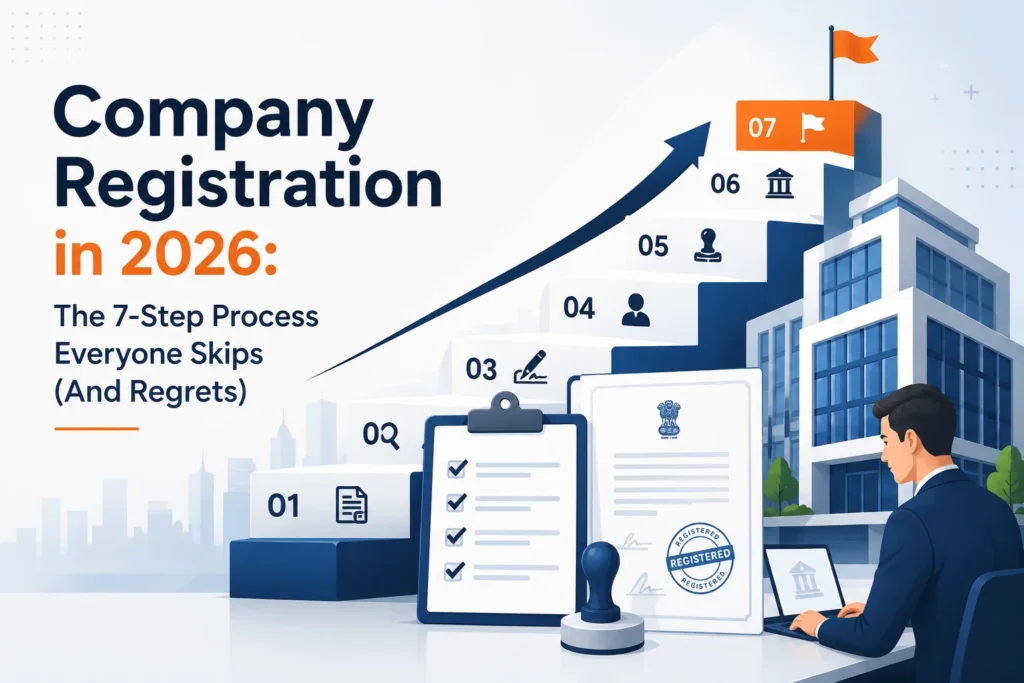
The Real Company Registration Process in 2026 (Step-by-Step)
- Get a Digital Signature Certificate (DSC) for all proposed directors — mandatory for signing forms electronically.
- Apply for Director Identification Number (DIN) through the SPICe+ form itself; no separate DIN application needed anymore.
- Reserve your company name via the RUN or SPICe+ Part A service on the MCA portal — check availability first to avoid rejection.
- File SPICe+ Part B with MOA, AOA, registered office proof, and identity/address documents of directors.
- Complete PAN and TAN application — bundled automatically within the SPICe+ form since the last MCA update.
- Receive the Certificate of Incorporation (COI) — usually within 7-10 working days if documents are clean.
- Open a current bank account and apply for GST registration to actually start operating.
Miss even one document mismatch in Step 4, and your entire filing gets sent back — resetting your timeline by two to three weeks.
A Real (Anonymised) Example
A Lucknow-based fintech founder came to us after his SPICe+ filing was rejected twice — once for a mismatched address proof, once for an incomplete MOA object clause. He’d spent nearly a month trying to self-file before switching to professional business registration services. The corrected filing was approved in nine days.
This is the pattern we see repeatedly: it’s rarely the big steps that trip people up — it’s the small formatting and documentation details the MCA portal doesn’t clearly explain.
Private Limited vs LLP vs Sole Proprietorship
| Feature | Private Limited | LLP | Sole Proprietorship |
|---|---|---|---|
| Legal identity | Separate | Separate | Same as owner |
| Liability | Limited | Limited | Unlimited |
| Funding-friendly | Yes | Limited | No |
| Compliance load | High | Medium | Low |
| Best for | Startups, scaling businesses | Professional services, small partnerships | Solo, low-risk businesses |
Company Registration vs LLP Registration: Which One Fits You?
If you’re planning to raise external funding or bring in investors, go with Private Limited company registration — it’s the only structure most investors will accept. If you’re a services business — consultants, agencies, small partnerships — LLP registration offers lower compliance with the same liability protection.
There’s no universally “better” option here. The right call depends on whether you need outside capital in the next 2-3 years.
Where Startup Registration Fits In
Startup registration under the Startup India scheme (via the Startup India portal) is a separate, additional step — not a replacement for company registration. You still need to incorporate first (Private Limited or LLP), then apply for Startup India recognition to unlock tax exemptions and easier compliance for the first few years.
Why Founders Increasingly Use Business Registration Services
Doing it yourself is possible. But most delays we see come from three repeatable mistakes: incorrect object clause drafting, mismatched address proofs, and DSC-related technical rejections. Professional business registration services exist specifically to catch these before the MCA does — turning a potential 3-4 week delay into a 7-10 day approval.
For founders based here, working with a company registration in Lucknow specialist also means someone who understands local municipal address-proof requirements and regional GST office timelines — details that generic national platforms often get wrong.
You can read more on how we structure GST filings alongside incorporation in our GST registration guide, and if trademark protection is part of your 2026 plan, our trademark registration service walks through timing it correctly after incorporation.
For the official process reference, the MCA’s SPICe+ guidelines remain the authoritative source — though, as this guide shows, reading them alone rarely prevents rejections.
Frequently Asked Questions
Typically 7-10 working days if all documents are accurate on the first submission. Filings with document mismatches can take 3-4 weeks due to resubmission cycles.
Yes, generally. LLP has lower government fees and simpler annual compliance, making it cheaper upfront and ongoing — but it limits your ability to raise equity funding later.
Yes. Startup registration under Startup India is applied for after your company or LLP is incorporated — it’s a recognition status, not a replacement for incorporation.
Technically yes, through the MCA portal directly. Most self-filers face at least one rejection due to documentation errors, which is why many opt for business registration services instead.
PAN, Aadhaar, passport-size photos, and address proof of all directors, plus registered office proof (rent agreement/NOC + utility bill) specific to your Lucknow address.
No, GST registration is separate and usually done immediately after receiving your Certificate of Incorporation, once you have your PAN and business bank account.
Conclusion
Company registration in 2026 isn’t harder than before — it’s just less forgiving of small mistakes. Get your documentation right the first time, choose the structure that matches your funding plans, and you’ll have a working, bank-ready company in under two weeks instead of two months.