
Still Not GST Registered? Here's What It's Actually Costing Your Small Business
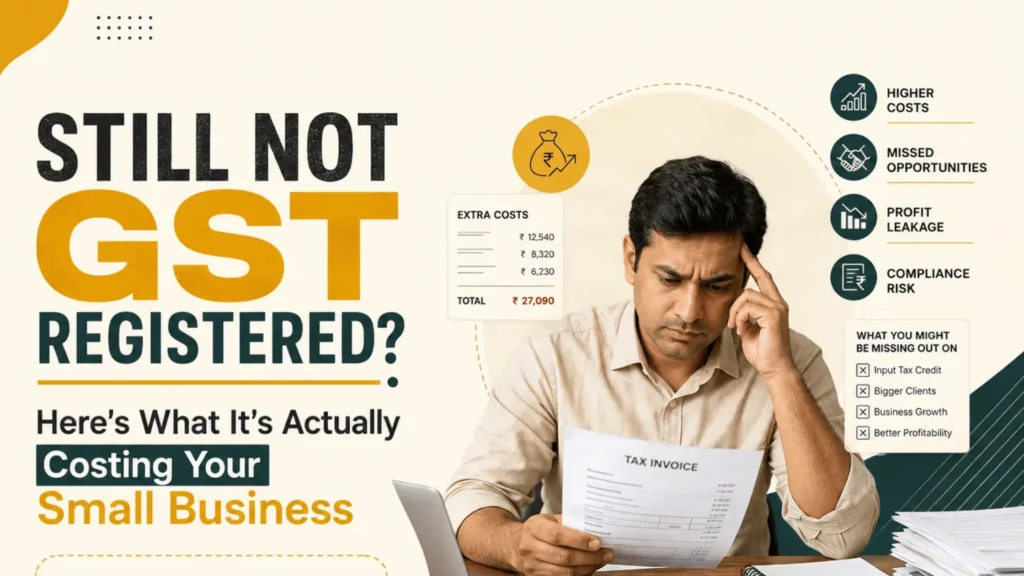
“We’re still small, GST can wait” — it’s one of the most common lines we hear from business owners in Lucknow. And it’s also one of the costliest assumptions in business today.
Delaying gst registration doesn’t just mean a compliance gap on paper. It means lost contracts, blocked input tax credit, and penalties that quietly stack up while you’re “waiting until it makes sense.” This isn’t a scare tactic — it’s a breakdown of the actual, avoidable mistakes we see businesses make by putting registration off.
What Does "Not GST Registered" Actually Mean Legally?
If your turnover crosses ₹40 lakh (goods) or ₹20 lakh (services) — or you’re doing any inter-state supply — and you haven’t registered, you’re operating outside the legal tax framework. You can’t legally collect GST, can’t issue valid tax invoices, and can’t claim input tax credit on your purchases. It’s not a gray area; it’s non-compliance from day one of crossing the threshold.
Mistake #1: Assuming “Small Business” Means “No Registration Needed”
Many owners believe GST registration is only for large companies. In reality, threshold limits are lower than most assume, and inter-state supply triggers mandatory registration regardless of turnover. Waiting until you “feel big enough” often means you’ve already crossed the legal deadline without realizing it.
Mistake #2: Underestimating the Penalty Structure
Operating without required registration isn’t a warning-first offense. Penalties apply as a percentage of tax due, with a minimum penalty regardless of amount owed — and deliberate evasion carries steeper consequences. GST compliance isn’t optional once you’re liable; it’s enforced retroactively from the date you should have registered, not from when you finally apply.
Mistake #3: Losing Input Tax Credit Silently
This is the cost most businesses don’t see coming. Without registration, you cannot claim input tax credit on the GST you pay to your own suppliers. Over a year, that’s real money — GST paid on raw materials, equipment, or services that you simply absorb as a loss instead of offsetting against your own tax liability.
“Every month without GST registration isn’t a delay — it’s input tax credit you’re never getting back.”
Mistake #4: Losing B2B Contracts Without Realizing Why
Most B2B clients, especially larger companies and government vendors, require a valid GSTIN before they’ll onboard you as a supplier. Without it, you’re invisible to an entire category of business — not because your product isn’t good enough, but because your paperwork disqualifies you before conversation even starts.
Mistake #5: Treating GST Filing as “Something to Figure Out Later”
Registration and filing are two different disciplines, and businesses that register late often scramble on GST filing services too — trying to catch up on returns, reconcile backdated invoices, and avoid late fees simultaneously. It’s far more expensive to fix this in bulk than to build the habit from day one.
A Real Scenario We See Often
A boutique manufacturing unit in Lucknow delayed GST registration for nearly eight months after crossing the threshold, assuming it wasn’t urgent since most of their sales were local. When a mid-sized distributor offered them a supply contract, the deal fell through at the final stage — the distributor’s procurement policy required a valid GSTIN before any purchase order could be issued. By the time registration was completed, the distributor had already onboarded a competitor.
The Real Cost of Delaying GST Registration
| What You Lose | Impact |
|---|---|
| Input Tax Credit | Non-refundable GST paid on all purchases since crossing threshold |
| Penalty Exposure | Percentage-based penalty applied retroactively from liability date |
| B2B Contracts | Disqualified from most corporate/government vendor onboarding |
| Business Credibility | Appears non-compliant or “too small” to serious clients |
| Filing Backlog | Late registration often means late/missed return filings too |
What to Do If You're Already Past the Deadline
- Confirm your liability date — the date you actually crossed the turnover or inter-state threshold, not today’s date
- Register immediately rather than waiting further — every additional month compounds exposure
- Gather backdated invoices to reconcile once registered
- Consult a GST consultant before self-filing backdated returns — errors here compound the problem
- Set up a compliance calendar going forward so filing deadlines don’t repeat the same pattern
Should You Register Yourself or Use GST Registration Services?
If you’re already past your liability date, this is exactly the scenario where doing it alone gets risky. Backdated liability calculations, penalty negotiations, and reconciling missed input credit require more than portal familiarity — they require someone who’s handled the clarification process before.
At Beginquest Services Pvt. Ltd. in Gomti Nagar, Lucknow, our recommendation is straightforward: if you’re registering on time with clean documents, self-filing is fine. If you’re already overdue, professional GST registration services typically save more in avoided penalties and correctly claimed credit than the consultant fee itself costs.
For businesses weighing this decision, our detailed guide on GST registration requirements and documents covers what to prepare before you apply, and our GST filing services overview explains what happens after registration is complete. You can verify current turnover thresholds and penalty provisions directly on the official GST portal or through the Central Board of Indirect Taxes and Customs notifications.
Frequently Asked Questions
You become liable for penalties calculated from your actual liability date, not your registration date. You also lose the ability to claim input tax credit for the entire unregistered period, and cannot legally issue GST-compliant invoices.
Late registration itself doesn’t automatically waive penalties — they’re generally calculated as a percentage of tax due for the unregistered period. Registering as soon as possible limits how much further exposure accumulates.
No — only businesses that cross the turnover threshold, engage in inter-state supply, sell via e-commerce, or fall under mandatory categories like reverse charge. Below threshold, with only local supply, registration is optional (though sometimes still beneficial).
Generally, no. Input tax credit is only available from the date of registration onward, which is why delaying registration means permanently losing credit on earlier purchases.
Because their own input tax credit depends on receiving GST-compliant invoices from registered suppliers. Working with an unregistered vendor blocks their credit claim, so most procurement policies exclude unregistered businesses entirely.
Yes, in most cases. Backdated liability calculations and penalty handling are more complex than fresh registration, and errors at this stage can compound into further scrutiny. A consultant experienced in GST compliance reduces that risk significantly.
Immediately. Every additional month typically adds to penalty exposure and extends the input tax credit you permanently forfeit. There’s no benefit to further delay once you know you’re past the threshold.
Conclusion
Delaying gst registration rarely feels like a decision — it feels like a non-event, right up until a lost contract or a penalty notice makes the cost visible. The businesses that avoid this aren’t the ones with perfect timing; they’re the ones who register the moment they cross the threshold, not the moment it becomes urgent.